

The demo lands. The prospect sees the value. Then someone asks: “Does it integrate with our core?”
If that answer feels unclear, slow, or risky, the deal stalls, no matter how strong the solution is.
For fintech leaders selling to banks and credit unions, core integration is oftentimes the most underestimated part of the go-to-market plan.
The Scale Problem
Most teams start with a simple mental model: there are a handful of major core banking vendors, Fiserv, FIS, Jack Henry, CSI, and Corelation. Build an integration into each, and you can reach most banks and credit unions in the market.
That model undercounts the problem badly. Each of those vendors operates multiple distinct core systems, not one. Fiserv alone runs DNA, Premier, and Signature, each with its own API structure, sandbox, and certification process. FIS runs Horizon, IBS, and Infinity Edge. Jack Henry maintains Symitar, SilverLake, and CIF 20/20. What looks like four or five integrations from the outside is closer to 30 once you count every sub-core, and even a single institution on a single core often requires multiple distinct APIs depending on what your product needs to expose.
This fragmentation isn’t an accident. These cores were built over decades of acquisitions and product evolution to run banks and credit unions well, not to make life easy for third-party fintechs. And prospects don’t ask “do you integrate with Fiserv?” They ask “do you integrate with our core?” which means a specific platform, in a specific configuration, at a specific institution.
Three Paths to Core Integration
Fintech teams generally choose one of three approaches, and the trade-offs compound the longer a company operates.
1. Build direct core integrations.
Your team negotiates partner agreements, builds and maintains each integration, and owns the certifications, the networking, and the fees. Partner program costs alone can run $3,000 to $6,000 a month per core before a line of code ships. A single direct core integration typically takes 9 to 18 months from signed agreement to live revenue, and it’s rarely a one-time cost: cores change APIs and authentication requirements continually, which means permanent maintenance headcount for as long as you support that core. Worth noting too: integrations don’t reuse cleanly across institutions on the same core, since every FI configures it differently. Each new customer still requires custom work.
2. Use a DIY integration platform.
Tools like MuleSoft offer better tooling and templates, cutting build time to roughly 3 to 6 months per core. But your team still owns the integration, the certification process, and the ongoing maintenance. You’ve traded some engineering effort for platform licensing costs. The burden moves; it doesn’t disappear.
3. Partner with an API connectivity layer.
You integrate once to a single API, and the provider handles partner programs, certifications, per-institution configuration differences, and ongoing maintenance across cores. Time to your first FI often drops to weeks instead of months. Adding a new core becomes the provider extending coverage, not a new project on your engineering roadmap. And when a core changes its API, that work happens at the provider layer, so your integration stays stable while everything underneath it shifts.
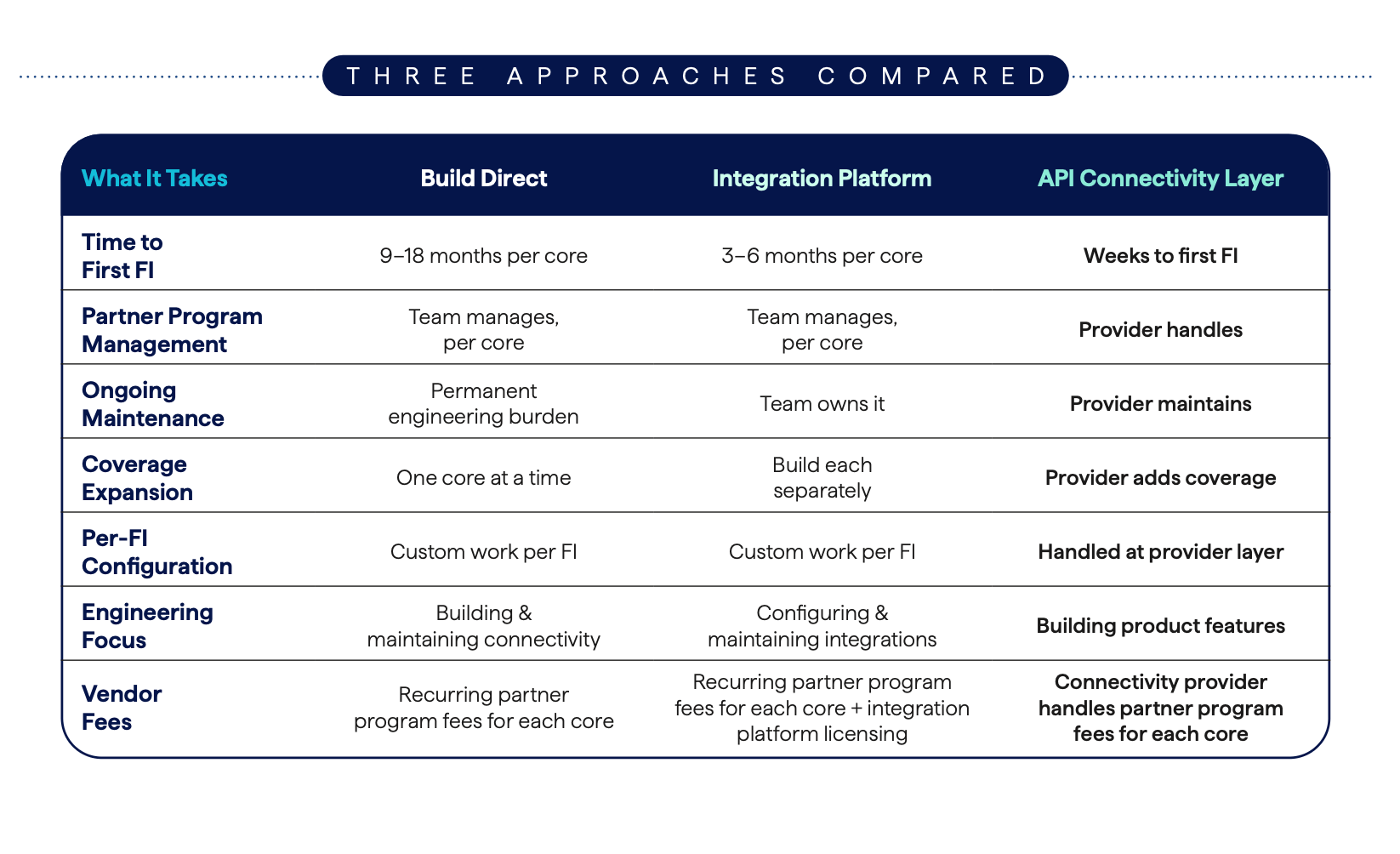
The result is straightforward: your team spends its time building what actually differentiates your product, not keeping connections to five different cores alive. The one thing you’re giving up is some direct control over what happens beneath the API, worth a second look only if your product needs something so specialized that no normalized layer could cover it.
What This Means for Your Roadmap
The instinct to build is understandable. Most engineering teams are technical enough to pull it off. The harder question is whether building and maintaining core connectivity is where your team creates the most value, or whether it’s an expensive detour from the product you’re actually trying to ship.
A few questions worth working through with your team:
Pipeline and coverage
- How many financial institutions do you need to reach in the next 12 to 24 months, and which cores do they run on?
- What’s the cost, in lost deals or delayed revenue, of saying “no” to a prospect because you don’t support their core yet?
Time to market
- Can you afford 9 to 18 months per core, or does your growth plan require broader coverage faster than that?
- What’s the opportunity cost of each month a deal sits stalled on a connectivity question?
Engineering capacity
- Is your team better spent building the features that differentiate your product, or maintaining infrastructure every fintech serving this market needs anyway?
- What happens to your existing integrations when you ship new features? Who’s funded to retrofit the ones you built first?
Economics
- What’s the fully loaded cost of building direct, including partner fees, engineering time, and ongoing maintenance headcount, compared to a partnership over the same timeline?
- What does your revenue trajectory look like if you could reach ten times more institutions in half the time?
There are legitimate reasons to build direct: if connectivity is your actual product, if you have unusual cost advantages already in place, or if your use case genuinely can’t work through a normalized layer. Those situations exist, and teams involved usually already know it.
For most fintechs selling to banks and credit unions, though, connectivity is the infrastructure that makes the product possible. It was never meant to be the product itself.
Ready to Go Deeper?
This is a snapshot of a more complete framework, including a full comparison of build costs, timelines, and total cost of ownership across all three approaches. For the full breakdown, along with a complete set of questions to bring to your own evaluation, read The Fintech’s Guide to Digital Connectivity.

