

Opening an account online should feel simple for the customer or member and controlled for the institution. Too often, it feels like neither.
An applicant starts an application, enters their information, reaches the signature step, and then the process slows down. A team member may need to review an exception or missing requirement. Someone may re-enter approved information into the core or another system. Another employee may confirm that every required document and signature is complete before the account is booked and archived. If the application requires additional identity or fraud review, imaging, or follow-up maintenance documents, those handoffs can multiply.
That is the account opening challenge for banks and credit unions that generic eSignature tools simply cannot solve. It is not about capturing a signature on a screen. It is about moving an applicant from application to active account without unnecessary friction, rework, or blind spots.
For executive leaders, this is a growth and service issue. Delayed or abandoned applications can weaken acquisition efforts and the first impression a new customer or member has with the institution. For operations teams, it is a consistency issue. Manual routing and exception handling create bottlenecks. For IT leaders, it is an integration and data-quality issue. If application data and signed documents do not move cleanly across systems, the institution inherits more manual work and more risk.
That is why eSignatures for account-opening should be treated as infrastructure, not a convenience feature. When signing is connected to workflow, policy controls, and downstream systems, it can help banks and credit unions reduce process fallout and improve visibility from application through account activation.
The workflow behind the signature
Online account opening rarely happens in one system. It typically involves an account-opening platform, document generation, identity and fraud checks, approvals, the core, an imaging or enterprise content management system, and exception queues. The exact sequence varies by product, ownership structure, risk profile, and institution policy.
The signature step usually sits near the end of the applicant-facing process, but it is not the end of the institution’s work. A banking-ready workflow may need to:
- Present the correct disclosures, agreements, and account documents based on the application.
- Support multiple signers, including joint owners or business representatives.
- Accommodate online, in-branch, remote, or blended signing when the process requires it.
- Route exceptions and approvals to the right employee or team.
- Return signed documents and audit records to the institution’s imaging or ECM system.
- Validate approved information and initiate the appropriate downstream updates.
- Trigger follow-up steps such as funding, welcome communications, or account-maintenance documentation.
This is where disconnected processes create operational drag. The applicant may finish signing while the account waits for a manual review, a missing attachment, an archive step, or an update to the core. Leaders may be able to see that a document was signed without knowing whether the account-opening workflow actually moved forward.
Why generic eSignatures can fall short
Many eSignature tools are effective at capturing a signature. Account opening requires a broader operating model.
A horizontal tool may leave the institution to assemble document preparation, routing, approvals, exception handling, archival, and downstream updates around the signing event. That approach can work for a simple agreement. It creates more exposure when the process involves multiple applicants, conditional approvals, required disclosures, core updates, and retention rules.
The key question is what happens after the signature is complete.
If employees still have to check the package, move documents between systems, re-enter information, and confirm that every step was completed, the institution has digitized the signature without resolving the workflow problem. Rekeying also creates another opportunity for a mismatch between the information the applicant approved and the information entered into the core or another system.
A banking-specific approach to eSignatures does not mean every account-opening process should be fully automated. Some applications require review or additional verification. The goal is controlled orchestration: automate predictable steps, route exceptions deliberately, and give employees the information they need to complete the work without searching across inboxes and applications.
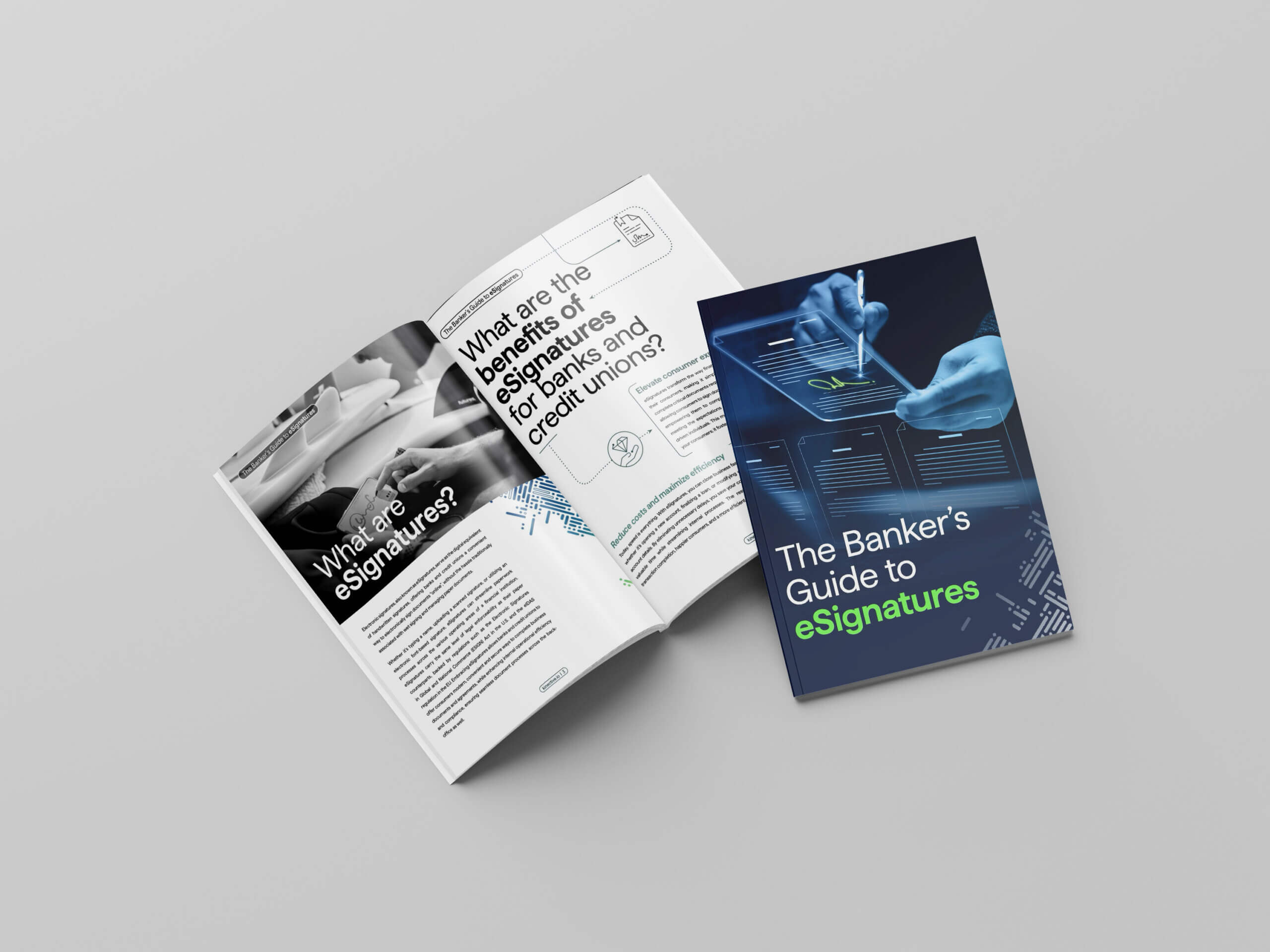
Make signing easier for customers and teams
Paper-based signing can add extra steps to everyday banking. Learn how electronic signatures can help streamline document workflows and let customers complete transactions wherever they are.
What banks and credit unions should evaluate
A practical evaluation should focus on the workflow around the signature, not a list of isolated features.
Workflow control before, during, and after signing
Account-opening documents do not all follow the same path. Rules should be able to account for product type, ownership, account features, approval status, and institution policy. Look for support for pre-sign preparation, signer sequencing, routing, approvals, alerts, and post-sign actions.
The objective is consistency. The institution should be able to define the process and run it reliably across channels, branches, and teams while still giving employees a clear path for exceptions.
A complete audit trail
Banks and credit unions need more than proof that a document was signed. They need traceability across the process: what happened, when it happened, who completed or approved each step, and where an exception occurred.
That visibility supports daily management, internal review, audit preparation, and accountability as volume increases. A process that feels manageable at low volume can become difficult to control when employees are tracking documents and approvals across multiple systems.
Integration with account-opening, core, and imaging systems
A signed package is useful only when it can move into the systems that run the institution. Evaluate how application data and completed documents move to the core, imaging or ECM, and other line-of-business systems.
Strong integration can reduce screen switching, manual rekeying, and duplicate handling. It can also help the institution confirm that the right record was archived and that approved updates were applied. The specific integration path will vary by core, account-opening system, and implementation, so institutions should evaluate real workflows rather than rely on a generic integration label.
Support for the full customer and member lifecycle
Account opening is connected to the work that follows it. Customers and members may need to add an owner, update an address, change account features, complete maintenance forms, or provide additional documentation.
An eSignature strategy that supports account opening and related document workflows can reduce fragmentation over time. It also gives operations teams a more consistent way to manage high-volume documents across the relationship.
A path from data aggregation to data activation
Collecting information in more systems does not create value by itself. Data activation means putting that information to work inside the process.
For account opening, that can mean using application data to prepare the right documents, validating fields before a downstream update, routing work based on status, and turning a completed signature into an operational action. The value appears at the moment that matters: when connected information helps the right person complete the right next step.
Automated document setup & Account-opening forms
One of the biggest friction points in account opening is document preparation. That is where automated document setup adds real value.
Instead of manually tagging fields and building templates from scratch, automated document setup can help admins detect signatures, fields, indexes, and roles more quickly. That reduces setup time, lowers the risk of mapping errors, and makes it easier to update forms when requirements change.
In practice, that means account-opening teams can get from document creation to signature-ready faster, with less manual effort and more consistency. It does not replace workflow control, but it does remove a common bottleneck at the front of the process.
A practical account-opening flow
The exact process differs across banks and credit unions, but the pattern is familiar:
Application and information capture. The customer or member selects an account, provides required information, and submits the application through an online or assisted channel.
Review and decisioning. Identity, fraud, sanctions, and other institution-defined checks occur. An application may proceed automatically or enter an exception queue for employee review.
Document preparation. The account-opening system generates the required documents based on the product, applicant information, and approval outcome.
Signing. The customer or member signs online, in a branch, remotely, or through a blended experience. Multiple signers may participate in the same session.
Completion and recordkeeping. Signed documents and audit information return to the institution’s archive or imaging system.
Activation and follow-up. Approved data moves to the core or another downstream system, and the institution completes funding, notifications, and any remaining maintenance steps.
The eSignature layer should help connect these stages. It should not create a new gap between them.
Questions to ask before choosing a solution
Before selecting or renewing an eSignature solution for account-opening, ask:
- Where does the process slow down after the customer or member signs?
- How many times is signed or application data re-entered into the core or another system?
- Which steps depend on email, spreadsheets, or manual follow-up?
- Can operations leaders see status, exceptions, and approval history?
- Does the workflow support online, in-branch, remote, and blended signing where needed?
- Are completed documents and audit records archived without a separate manual process?
- Can the institution extend the same approach to maintenance documents and other high-volume workflows?
If the answers point to handoffs, rekeying, toggling, or limited visibility, the institution may have an integration and workflow problem rather than a signature problem.
First impressions matter
Banks and credit unions do not create a better digital account-opening experience by digitizing one step and leaving the rest of the process disconnected. They create it when the signature triggers clean, governed action across the workflow.
That means preparing the right documents, supporting the right signers, enforcing approvals, routing exceptions, preserving auditability, updating downstream systems, and making the resulting data useful.
When those pieces work together, eSignatures become part of a smarter and more controlled account opening model, creating a seamless experience from application to funded account whether the consumer starts online, in a branch, or both.

