

At Kinections25, Heather Deneault from Denison State Bank shared something that made the room go quiet.
“We had loans being signed and the folks that were booking and funding those loans had no idea that the loan had been signed because it didn’t come to them or somebody forgot to say, hey, I signed that loan today. And so we actually did run into loans not getting funded.”
Read that again. A customer went through the entire loan process—application, approval, document preparation, signing—and then… nothing. The loan didn’t get funded. Because somewhere in the chain, someone forgot to tell someone else that documents were signed.
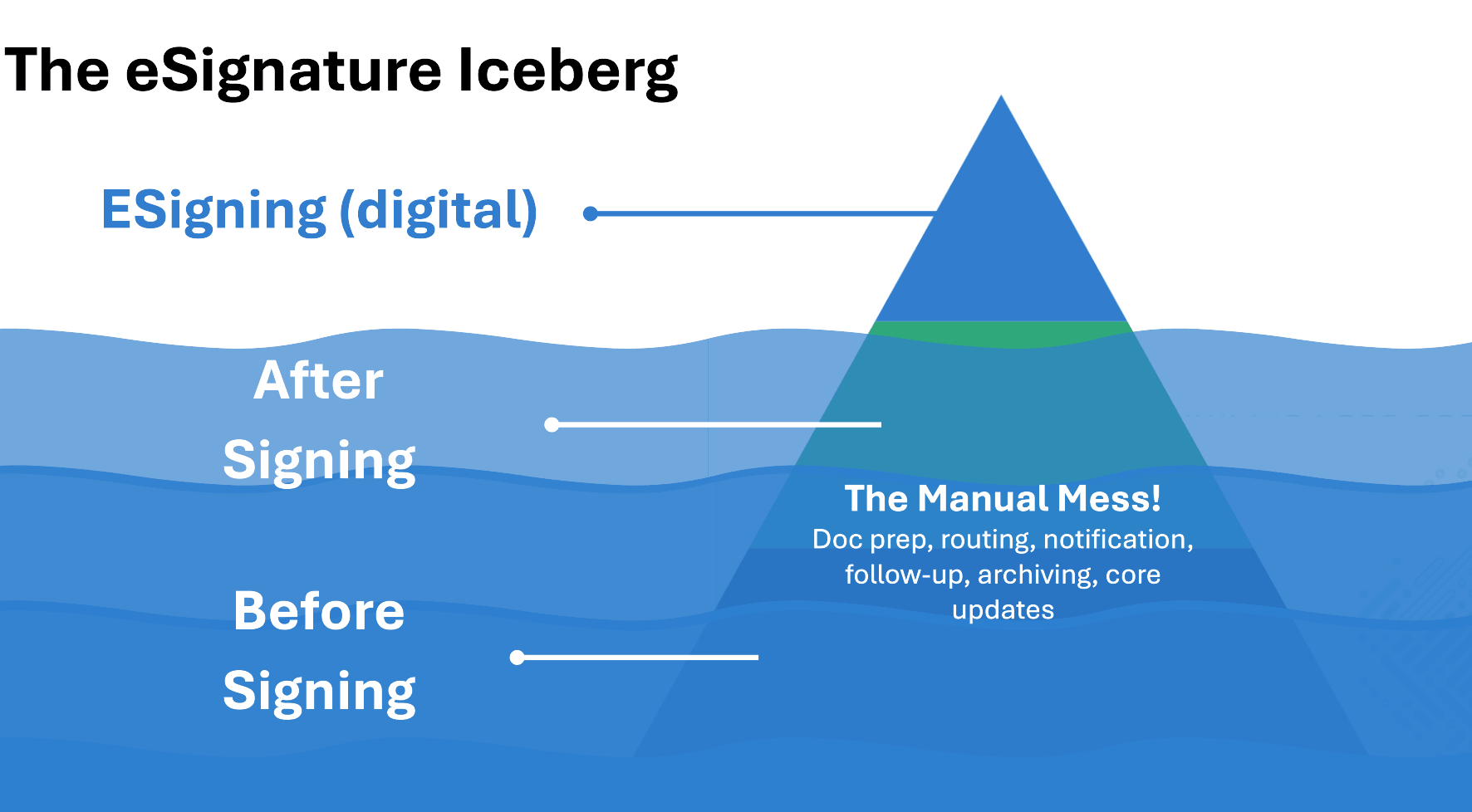
This isn’t an isolated incident. It’s a symptom of a problem that exists in virtually every financial institution that relies on e-signatures without proper document workflow automation: the signing is digital, but everything around it is still manual.
Sound familiar?
This is one of the many problems that Intelligent Banking can solve. When operations are modernized and your systems can connect, document workflows can actually flow – automatically.
The E-Signature Illusion
Here’s what most e-signature implementations look like:
A document gets generated in some system. Someone sends it to a customer for signature. The customer signs. The signed document goes… somewhere. Then someone needs to remember to check that it was signed, tell the right people, make the right updates, archive the right files.
The actual signing moment? That’s digital. That’s efficient. That works.
Everything before and after? That’s still human memory, manual processes, and hope that nothing falls through the cracks.
This is what happens when institutions adopt e-signature technology without workflow automation. They digitize one step while leaving everything else analog. They create the illusion of digital transformation while most of the process remains vulnerable to human error.
And as Heather’s story illustrates, the consequences aren’t theoretical. Real loans don’t get funded. Real customers are left wondering why they’ve committed to a financial obligation that their bank can’t seem to complete.
What Real Document Workflow Automation Looks Like
Eric Soya from United Bank explained the concept:
“The one thing that I really like about SignPlus and why we went with SignPlus from the beginning is the workflows. That’s really the differentiator. We can develop each of those workflows so that they’re customized to that need or that use.”
A document doesn’t just get sent and signed—it follows a predefined path. When a signature is captured, the system automatically notifies the next person in the chain. If an action isn’t taken within a specified time, an alert fires. Every step is logged, creating an audit trail of not just the signature, but the entire process around it.
The workflow can include approvals before documents go out.
It can route completed documents to the right departments and roles automatically.
It can trigger updates in other systems.
It can archive everything to the right location with the right indexing.
No one has to remember to tell anyone anything. The system handles the routing, the notifications, and the tracking. Human beings can focus on exceptions rather than monitoring every routine transaction.
Moving Beyond the Signature
The gap between basic e-signatures and true document workflow automation isn’t just technical—it’s operational. One digitizes a single moment. The other transforms an entire process. That’s what Intelligent Banking looks like in action.
In our next post, we’ll explore how document workflow automation expands beyond lending into unexpected departments and why the use cases nobody anticipated often deliver the biggest impact.

